AI Workflow Handoff Checklist: Who Owns Automation After Launch?
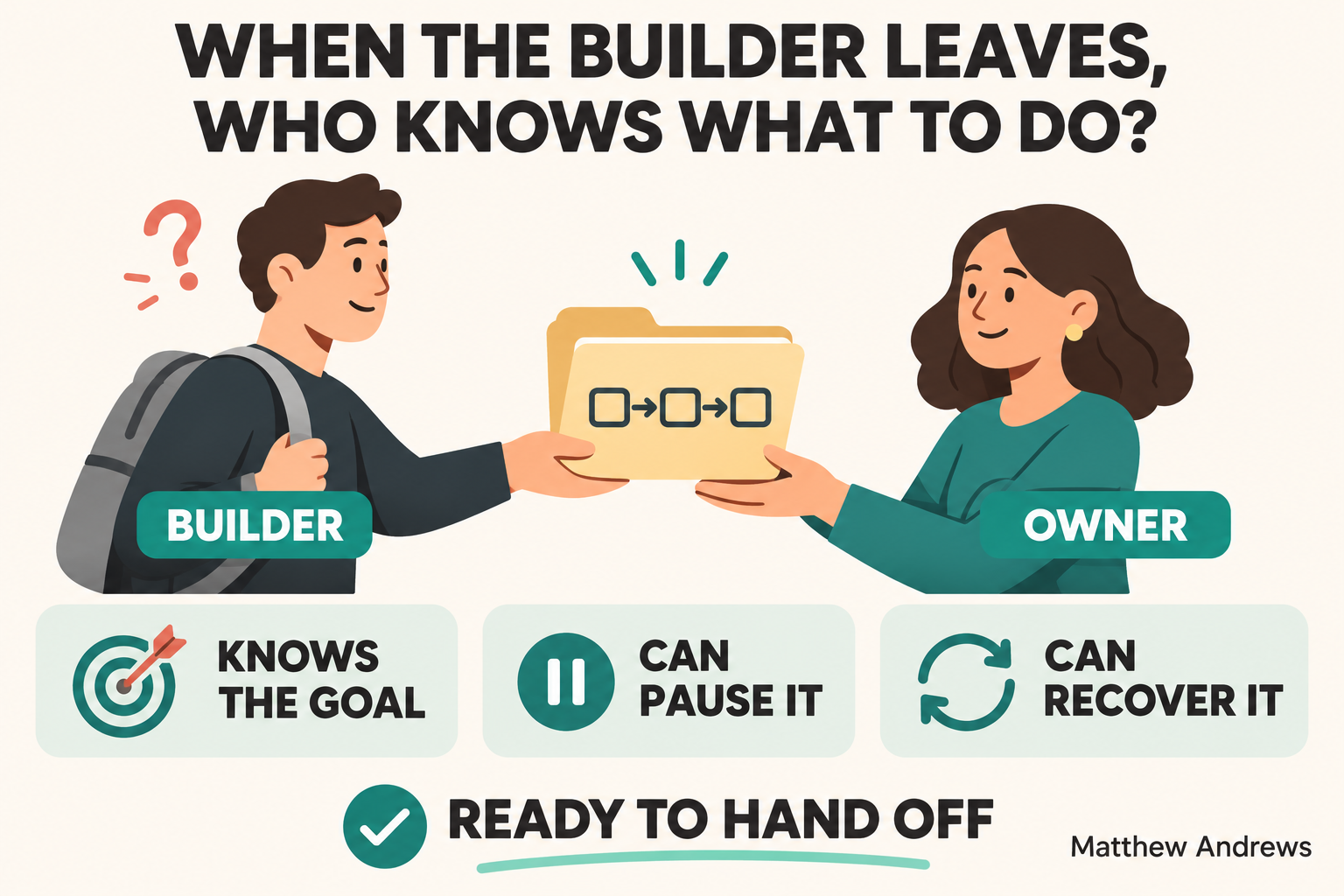
Quick answer: After launch, an AI workflow should have a named business owner, a named technical owner, documented permissions and dependencies, a tested recovery path, and a scheduled review. The builder may support the handoff, but the workflow should not depend on the builder remaining available.
What this article answers: Who owns an AI workflow after launch, what must be handed over, and how can a team test that the handoff is safe?
AI workflow handoff checklist
- Name the business and technical owners.
- Document the workflow’s purpose, inputs, outputs, rules, and limits.
- Define who can pause, change, approve, or restore it.
- Write the recovery and escalation path.
- Test the handoff with a realistic failure or process change.
- Schedule the next ownership review.
The person who built an AI workflow is not automatically the person who should own it after launch.
1. Name two owners when responsibilities differ
The business owner decides whether the workflow still serves the process. The technical owner maintains the implementation, connections, permissions, and recovery steps.
In a small team, one person may hold both roles. That is fine if the responsibilities are still written down. An owner’s name should not be inferred from whoever created the workflow or receives an error notification.
2. Document the outcome, not just the steps
A handoff document should start with the decision or result the workflow supports. Then record the inputs it relies on; the systems and accounts it touches; the rules or prompts that affect its output; the human approvals it requires; the situations it does not handle; and the evidence that shows a run succeeded.
This gives the next owner enough context to distinguish a technical failure from a process change.
3. Define who can pause and change it
The handoff should identify who may pause the workflow, change its rules or routing, rotate or remove access, approve a new integration, and restore the previous version.
Do not leave these decisions inside the builder’s private knowledge. A workflow that can only be repaired by its original creator has not really been handed off.
4. Include the recovery path
“Contact engineering if something goes wrong” is not a recovery plan.
The owner should know how to identify an affected run, stop additional processing, preserve relevant evidence, correct the cause, and resume safely. If the workflow produces an output that someone must review, define what happens when the reviewer rejects it or does not respond.
5. Test the handoff before launch
The final handoff test should use a realistic failure or change, not only a successful example. Ask the backup owner to:
- find the workflow and explain its purpose;
- identify the current version and dependencies;
- locate the run evidence;
- pause or route a failing case safely;
- explain how the process would be changed and retested.
If that person cannot do those things, the gap is in the handoff—not in their willingness to help.
6. Schedule the next ownership review
Ownership is not a one-time field. Processes change, people change roles, permissions expire, and integrations are replaced.
Set a review date and ask what changed in the process, what exceptions appeared, whether people created workarounds, and whether the output still supports the intended decision. The result should be a visible keep, revise, pause, or retire decision.
The short answer
After launch, automation should have a named business owner, a named technical owner, a documented recovery path, and a tested handoff.
The builder can help with the transition, but the workflow should not depend on the builder remaining available. If nobody can explain who owns the outcome or how to stop and recover the workflow, it is still in development—no matter how polished the demo looks.
Subscribe for Future Posts
Follow my writing on technology, leadership, and building better systems. Add the blog’s RSS feed to your preferred feed reader to receive future posts.